Bamini to Unicode: Converting Government & Court Tamil Records (2026)
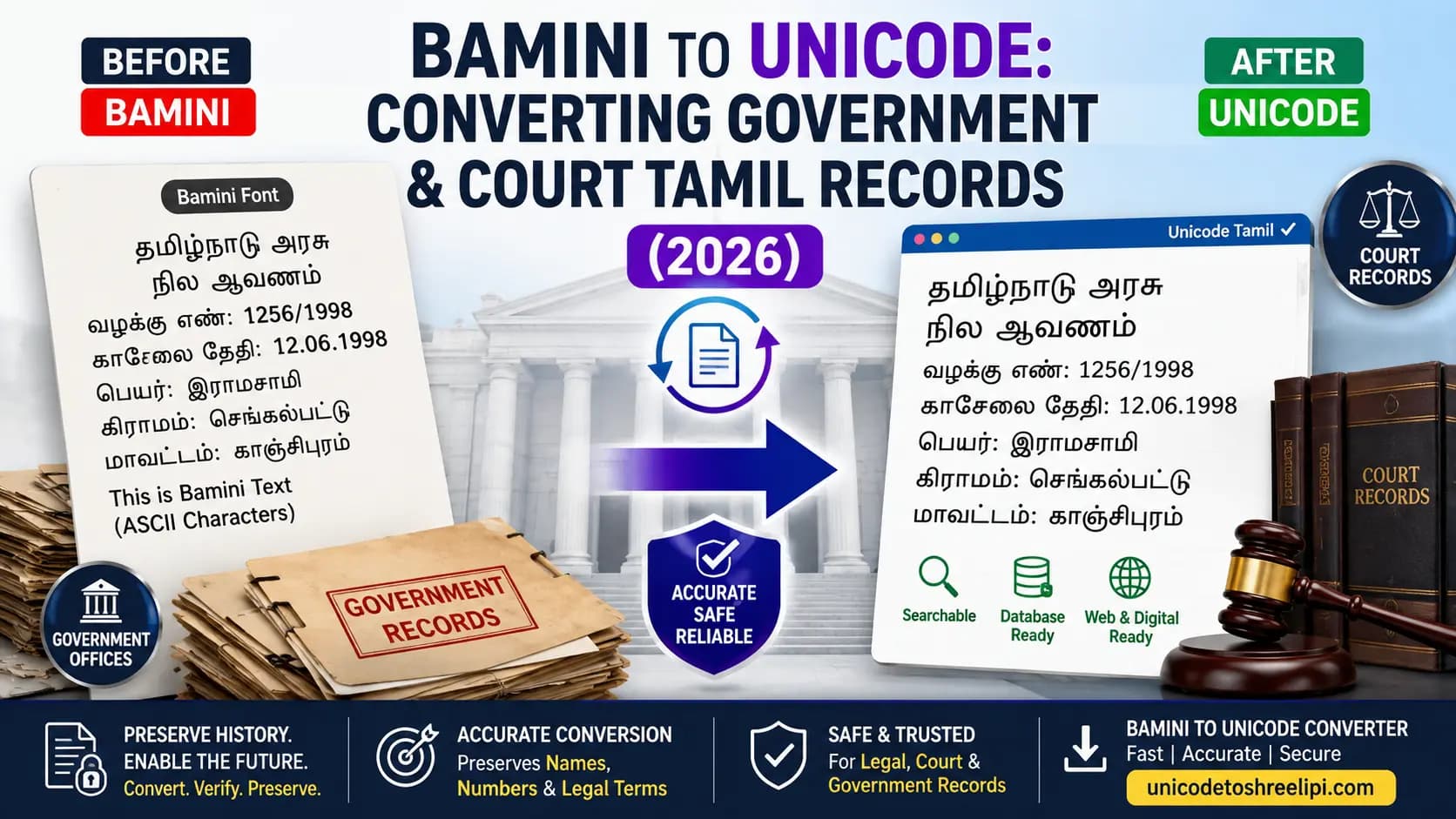
Somewhere in almost every government and court office across Tamil Nadu, there's a filing cabinet — physical or digital — full of Tamil records typed decades ago in Bamini. Land documents, case files, office correspondence, old notices. They read perfectly well to a human eye once opened in the right software. To a computer, a database, or a search system, they are unreadable.
That gap is becoming a real operational problem. As government services, RTI systems, and court processes move further online, records that exist only in Bamini simply don't function the way modern digital systems expect them to. This guide explains exactly why that happens, and how to convert these records to Unicode correctly — without losing accuracy on documents where accuracy genuinely matters. The Bamini to Unicode Converter at unicodetoshreelipi.com handles the character mapping correctly for this kind of work.
Table of Contents
Why So Many Government and Court Records Are Still in Bamini
Bamini was used for decades across Tamil Nadu in schools, government offices, DTP publishing, and legal papers, long before Unicode Tamil became the standard. An entire generation of typists, clerks, and office staff were trained specifically on the Bamini layout, and huge volumes of official documentation were created using it during that period.
Even now, many government and court offices continue to file, print, and archive certain Tamil records in Bamini, simply because that's the format their existing templates, staff training, and internal systems were built around — even as the public-facing side of government has largely shifted to Unicode. This is exactly why old and new records can exist side by side in two completely different, non-interchangeable formats within the same office. For a deeper look at why these systems differ at a technical level, see our Bamini vs TSCII vs Unicode guide.
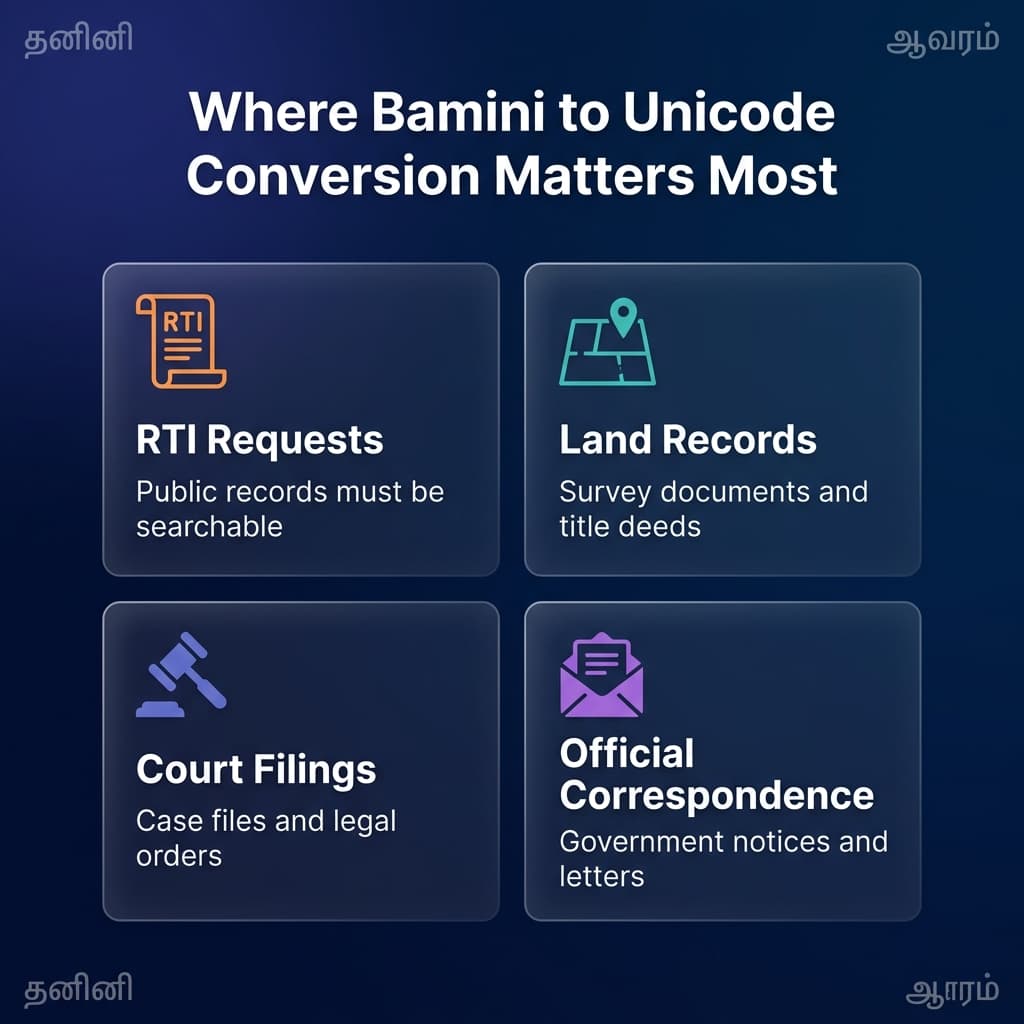
From RTI responses to land records to court filings — this is where Bamini-to-Unicode conversion matters most.
Why This Actually Matters
The core problem is simple: Bamini text is stored as plain ASCII characters, not as true Tamil character codes. A search engine, case-management database, or digital archive system has no way to recognise Bamini content as Tamil at all — it just sees ordinary English letters and symbols that happen to display as Tamil once a specific font is applied.
This has direct, practical consequences. Bamini-based records cannot be searched by keyword in a digital system. They cannot be indexed for RTI or public records portals. They cannot be read by accessibility tools. And they cannot be reliably copied into modern case-management, e-governance, or digitization platforms without the text turning to garbled characters the moment the Bamini font isn't applied.
Converting these records to Unicode isn't a cosmetic upgrade — it's what actually makes them usable inside any modern digital system. The Bamini to Unicode Converter at unicodetoshreelipi.com is built specifically for this kind of conversion, handling the full Tamil character set including combining marks and ligatures.
Key Takeaway
Bamini-based records are invisible to search engines, RTI portals, and digital case-management systems. Converting to Unicode is what makes them genuinely usable in modern government infrastructure.
What Makes Bamini to Unicode Conversion Different From Ordinary Text
Converting a casual paragraph from Bamini to Unicode is low-risk — a small error is easy to spot and fix. Government and court records are a different situation entirely. Names, dates, land measurements, case references, and legal terminology all need to convert with complete accuracy, because an error in an official record isn't just a typo — it can change the meaning or validity of the document itself.
Tamil script includes complex combining marks and ligatures, where a single visible character is actually built from multiple underlying components. Accurate Bamini to Unicode conversion has to preserve the correct logical order of these components, not just swap Bamini characters for similar-looking Unicode ones. A conversion process that gets this ordering wrong can silently produce text that looks almost right but is technically incorrect — which is far more dangerous in an official record than an obviously broken one.
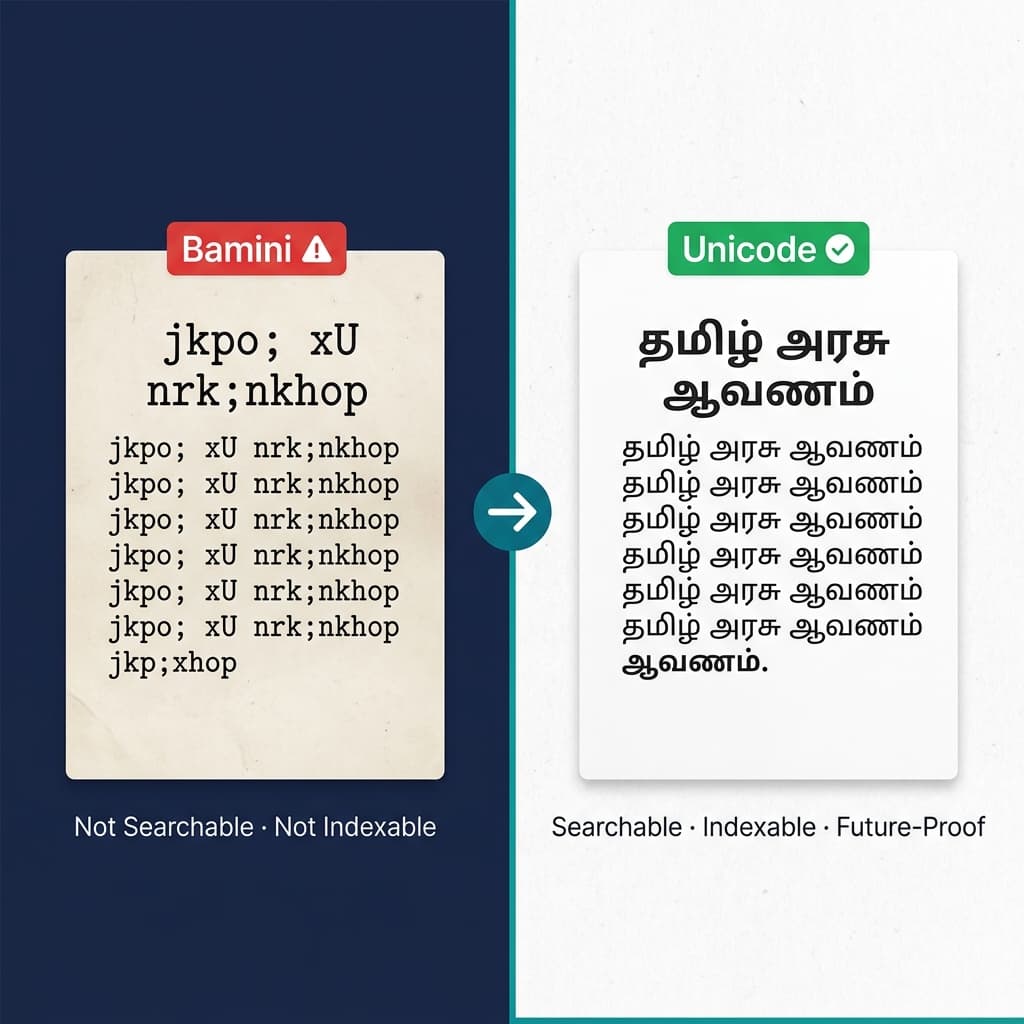
Same official record, same wording — but only one version is searchable, indexable, and future-proof.
How to Convert Bamini to Unicode Official Records Safely
For any document with legal or administrative weight, treat conversion as a careful process, not a single copy-paste action.
- Convert in smaller sections. Work paragraph by paragraph or page by page rather than pasting an entire long document at once. This makes it far easier to catch a mapping error early, before it spreads across dozens of pages.
- Verify each section carefully. After each section is converted, read it back carefully against the original Bamini document, paying close attention to names, numbers, dates, and any legal or technical terms, since these are the details where a small error carries the most consequence.
- Keep the original Bamini version archived. Never treat the conversion as a replacement for the source record — it should exist as a parallel, more accessible copy, not a substitute that discards the original.
- Apply the same principle to bulk projects. For very large digitization projects — bulk land records, old case archives, multi-decade office correspondence — batch conversion tools save enormous time, but section-by-section verification still applies before any converted text is treated as final or official.
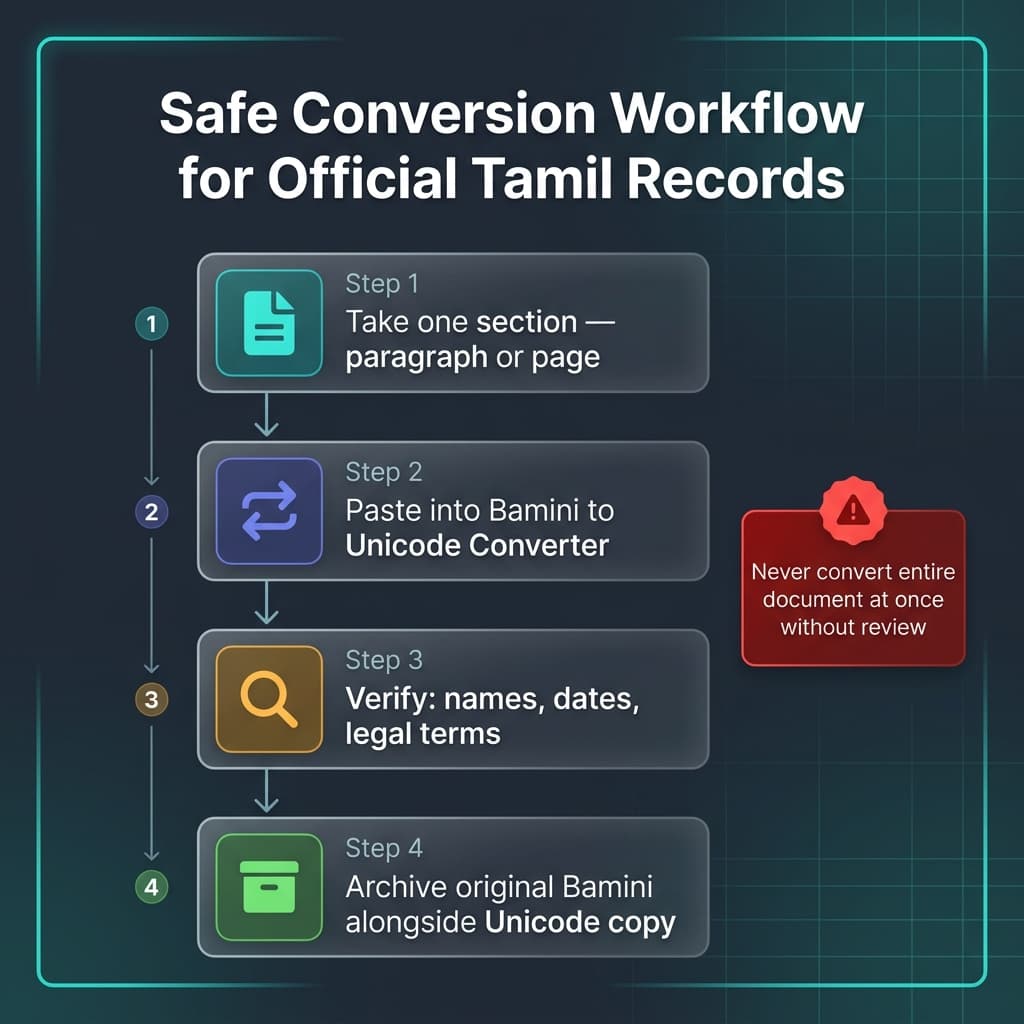
For official and legal records, converting and verifying in sections is safer than converting an entire file at once.
Common Mistakes to Avoid
- Converting the entire document at once without section-by-section review
- Discarding the original Bamini file after conversion — always preserve both versions
- Treating converted output as final without checking names, dates, and case references
- Using a generic Unicode converter not calibrated for Bamini's specific character mapping
Conclusion
Bamini served Tamil Nadu's government and court offices well for decades, but it was never built for a world of searchable databases, RTI portals, and digital case management. Converting these records to Unicode is what makes them genuinely usable in that world — searchable, indexable, and accessible — without discarding the original documents that remain the true source record.
For anyone handling this kind of conversion, section-by-section accuracy matters more than speed. The Bamini to Unicode Converter at unicodetoshreelipi.com handles the character mapping correctly, but for records with legal or administrative weight, careful human verification alongside the tool is what ultimately keeps the digitized record trustworthy. You may also find our Unicode to Bamini Converter Guide useful for understanding the reverse workflow when working with existing Bamini templates.
Frequently Asked Questions
Ready to convert? Our main tool handles Unicode ↔ Shree Lipi with the same accuracy and speed — instantly in your browser.
Try Unicode ↔ Shree Lipi Converter